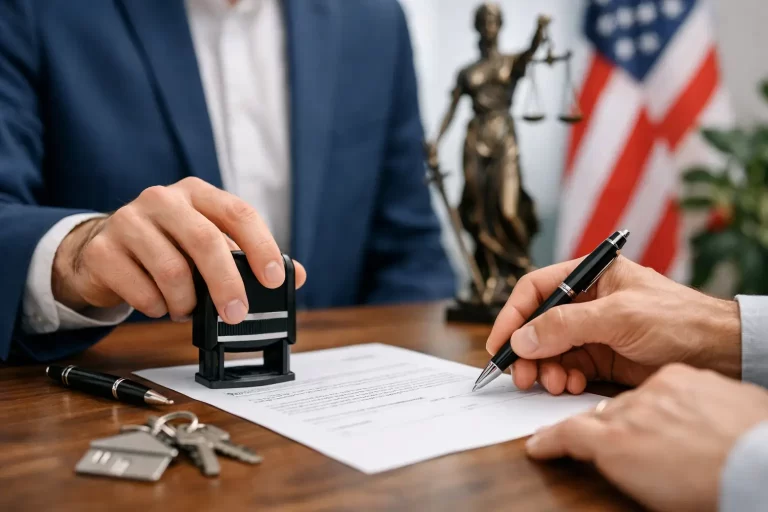

A notarization has a few moving parts, and missing any one of them sends you home to try again. The person signing, the identification that proves who they are, and the document itself all have to line up before a notary can act.
This guide lists what to bring, explains the acceptable forms of ID, and shows why the document usually stays unsigned until you arrive. It also walks through the common reasons a notarization gets refused, so none of them surprise you.
Anyone headed to a bank, a shipping store, a law office, or a mobile notary can use this as a pre-appointment checklist. The rules shift a little from state to state, yet the core requirements hold almost everywhere.
Your three essentials at a glance
Every notarization rests on three things you control. Bring all three and most appointments wrap up in minutes.
The signer must show up in person. In Montana, for example, the person whose signature, oath, or acknowledgment is being notarized must appear to the notary at the time the act takes place. A friend or relative cannot stand in for you.
Expect to pay at the appointment. Fees vary by state and by whether the notary travels to you, so confirm the cost when you book.
Which IDs a notary will accept
A notary’s core job is to confirm you are who you say you are. That proof is called satisfactory evidence of identity, and a government photo ID is the usual way to provide it.
Common acceptable IDs include a state driver’s license, a state ID card, a U.S. passport, a permanent resident card, and a military ID. When a state leaves the choice to the notary, the recommended standard is a government-issued ID bearing a photo, a physical description, and the bearer’s signature.
Some documents carry your name but still fall short. The National Notary Association lists temporary licenses, Social Security cards, credit cards, school IDs, and library cards among forms it treats as unacceptable.
| Form of ID | Status |
|---|---|
| State driver’s license or ID card | Accepted |
| U.S. passport or passport card | Accepted |
| Permanent resident or military ID | Accepted |
| School, work, or library card | Rejected |
| Social Security or credit card | Rejected |
| Expired ID | Check state rule |
Expiration matters, and the rule is not uniform. Colorado accepts an ID that is current or expired for one year or less, while many notaries insist on an unexpired ID as best practice. Check your card’s date before you leave, because an expired license often stops the appointment cold.
The document: complete and usually unsigned
Bring every page, not just the signature page. A notary reviews the whole document to confirm it is complete and to find the notarial certificate that states which act you need.
Blank fields are a problem. Notaries routinely refuse documents with empty spaces, because gaps leave room for someone to alter the paper after it is certified. Fill in everything except the notarial certificate, which the notary completes.
Now the part that confuses many people. Whether you sign ahead depends on the type of notarization your document calls for.
Acknowledgment vs. jurat. For an acknowledgment, you may sign beforehand, then appear and confirm the signature is yours. For a jurat, you must sign in front of the notary and take an oath or affirmation.
Because the two acts handle signing differently, the safe default is to leave the signature blank. California confirms that an acknowledgment lets the document be signed before you appear, while a jurat requires the signer to sign in the notary’s presence. If you are unsure which applies, ask before you put pen to paper.
Common reasons a notarization gets turned away
Most refusals come down to a handful of causes, and nearly all are fixable. Knowing them ahead of time saves a return trip.
Figure 1. Most refusals trace back to a few fixable problems you can clear before you arrive.
A notary must decline when the signer is not present, when identity cannot be established, or when the document has blank spaces. A notary must also decline if the signer does not appear to be acting willingly and aware. A notary can also refuse if a required witness is missing or if the signer seems confused or pressured.
Two refusals catch people off guard. A notary cannot act when they have a financial interest in the transaction or are a party to it. Several states also bar notarizing for a spouse, parent, or child, so a neutral notary is the safer choice.
A notary can refuse your document because they dislike what it says.
A notary may not decline simply because of disagreement with the content for political, religious, or personal reasons.
Name mismatches and missing ID
The name on your ID should match the name on the document. A mismatch is one of the most frequent reasons a notarization stalls, even when the photo clearly shows you.
If your name changed through marriage or a court order, bring supporting paperwork such as a marriage certificate. That extra document can bridge the gap between an older ID and a newer name on the form.
What if you have no acceptable ID at all? Some states allow a credible witness, a person who knows you, appears in person, and swears to your identity. California permits two credible witnesses who each present a valid ID and do not benefit from the document. These rules are specific and not available everywhere, so call ahead rather than arriving empty-handed.
A simple way to prepare
A short routine the night before removes almost every obstacle. Run through these steps and your appointment should take only minutes.
- Check your ID. Confirm it is current, government-issued, and shows your photo and signature.
- Match the names. Make sure the name on your ID matches the document, and pack proof if it changed.
- Gather the full document. Bring every page and any attachments, with all fields filled except the notarial certificate.
- Hold your signature. Leave signature lines blank unless the notary confirms you may sign ahead.
- Line up everyone. Arrange for each signer and any required witnesses to attend, each with valid ID.
When in doubt, call first. A quick question about ID, witnesses, or fees prevents the most common wasted trips.
Conclusion
A notarization succeeds on three things: the right ID, a complete document, and the signer present in person. Get those lined up and the act itself is brief and routine.
The sticking points are predictable. Expired or mismatched ID, blank fields, a signature made too early, or a missing witness account for most turned-away appointments. Each one clears up with a little preparation.
State rules differ on expired ID, credible witnesses, and which notarial act fits your document. When the details are unclear, a short call to the notary settles them before you travel. A few minutes of checking the night before is the surest way to finish in one visit.
Key takeaways
- Bring a current, government-issued photo ID with your photo and signature; school, credit, and Social Security cards do not qualify.
- Carry every page of the document, complete, with only the notarial certificate left blank.
- Leave your signature blank until the notary confirms whether the act is an acknowledgment or a jurat.
- Most refusals trace to an absent signer, bad ID, blank spaces, a name mismatch, or a missing witness.
- State rules on expired ID and credible witnesses vary, so call ahead when anything is uncertain.
Can you use an expired ID at a notary?
It depends on your state. Colorado accepts an ID expired for one year or less, while many notaries require an unexpired ID as best practice. Check your card’s date and confirm the local rule before you go.
Should you sign the document before you arrive?
Usually no. For a jurat you must sign in front of the notary, and for an acknowledgment you may sign ahead but still appear in person. Leaving the signature blank is the safe default until the notary confirms the act.
What happens if you do not have a photo ID?
Some states let a credible witness who personally knows you swear to your identity. California allows two credible witnesses, each presenting a valid ID, who gain nothing from the document. The rules are specific, so ask the notary well before the appointment.
Can a notary refuse to notarize your document?
Yes, in set situations. A notary must decline when the signer is absent, identity cannot be verified, the document has blank spaces, a required witness is missing, or the signer seems confused or pressured. A notary cannot refuse simply because of disagreement with the content.
Do you need to bring every page?
Yes. Bring the complete document, not just the signature page, so the notary can confirm it is whole and locate the notarial certificate. Include any attachments or exhibits as well.
Sources
- California Secretary of State. Notary Public Handbook. sos.ca.gov
- Colorado Secretary of State. Notary Public FAQ on Duties. sos.state.co.us
- Montana Secretary of State. Montana Notary Public Handbook. sosmt.gov
- Florida Legislature. Statutes Section 117.05. leg.state.fl.us
- National Notary Association. Determine if ID is Acceptable for Notarization. nationalnotary.org