
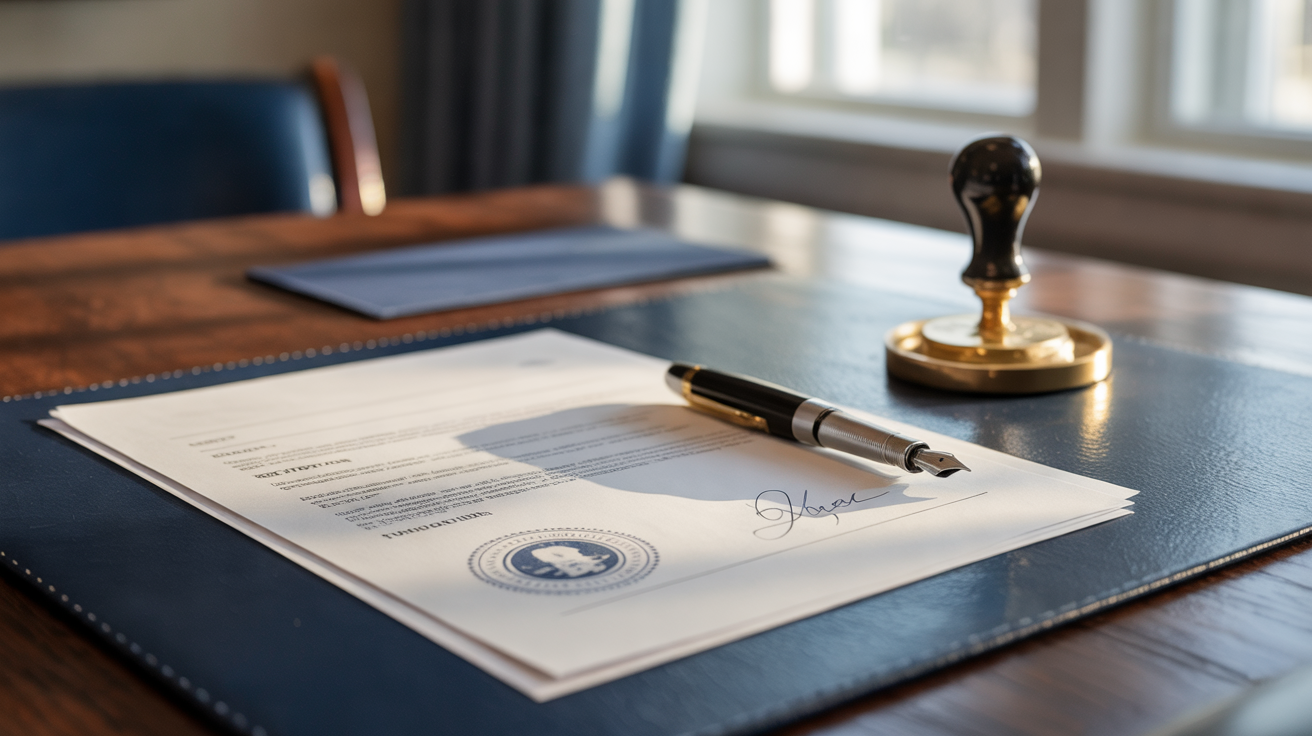
A notary certificate is the short block of wording that turns a signed page into a notarized document. The two most common versions are the acknowledgment and the jurat. They look similar, yet they certify very different things.
This guide explains what each act proves, how the steps differ, and how to tell which one your document needs. It also shows why using the wrong certificate can void the notarization and force you to start over.
The information helps anyone bringing a document to a notary. That includes a homeowner signing a deed, an executor handling an estate, a small business owner filing an affidavit, or a freelancer verifying a sworn statement. Knowing the difference before your appointment saves a second trip and keeps your document valid.
The core difference in one minute
Both acts start the same way. For either one, you appear in person and prove who you are. The split comes next.
An acknowledgment confirms that you signed a document willingly. Under the model notary law, an acknowledgment means a declaration before a notarial officer. The individual confirms signing a record for the purpose stated in the record. No oath is involved.
A jurat is different. A verification on oath or affirmation means a declaration, made by an individual on oath or affirmation before a notarial officer, that a statement in a record is true. The jurat adds a sworn promise that the contents are truthful.
What an acknowledgment actually proves
An acknowledgment focuses on the signature, not the words above it. The notary confirms who you are and that you acknowledged signing.
You do not have to sign in front of the notary for this act. Documents requiring an acknowledgment may be signed by the principal signer before notarization or during notarization. A signature already on the page is fine, as long as you personally confirm it is yours.
The act says nothing about whether the document is accurate. An acknowledgment does not certify the truth of what is in the document, just the identity of the person signing it. Deeds, powers of attorney, and many contracts use this act because they record an agreement rather than a sworn fact.
Tip to spot it. Acknowledgment certificates usually contain the phrase “acknowledged before me” or similar wording. If you see those words, your document needs an acknowledgment.
What a jurat demands
A jurat raises the stakes by adding an oath. It is used when a document contains facts you must swear are true.
First, you must sign in front of the notary. Documents requiring a jurat may only be signed by the principal signer in the notary’s presence. A page signed earlier must be re-signed during the appointment.
Second, the notary administers an oath or affirmation out loud, and you respond. The notary must administer a spoken oath or an affirmation, and the signer must respond out loud. Skipping that step breaks the act. Affidavits and sworn statements are the classic examples, and jurat certificates often read “subscribed and sworn to.”
Figure 1. Both acts share identity and appearance. Only the jurat adds in-presence signing and a sworn oath.
| Requirement | Acknowledgment | Jurat |
|---|---|---|
| Personal appearance | Required | Required |
| Proof of identity | Required | Required |
| Sign in notary’s presence | Not required | Required |
| Oath or affirmation | Not required | Required |
| Certifies truth of contents | No | No |
Oath or affirmation: your choice, equal weight
A jurat lets you choose how to make the sworn promise. Both options bind you the same way.
An oath references a deity, while an affirmation leaves religion out. An oath involves a pledge to a deity, while an affirmation is a solemn pledge without a religious reference. Both carry the same legal weight. People who prefer not to swear religiously can affirm instead and lose nothing.
Either way, you must answer aloud. A simple spoken “I do” or “I swear” completes the step. The notary then finishes and seals the jurat certificate.
Who picks the certificate — and why it is not the notary
A common surprise catches many signers off guard. The notary cannot choose the act for you.
Instead, the signer or the receiving agency decides. The signer or document recipient decides whether they need an acknowledgment or a jurat. The notary does not make this choice. If the document itself names the act, that settles it. If it does not, ask the agency that will receive it.
A jurat is always the stronger, safer option, so request one to be sure.
Neither act is automatically stronger. An acknowledgment will not supply a sworn statement, and an oath will not fix an acknowledgment that was required but never taken. Match the act to the document.
How to confirm the right act before you go
A few minutes of prep prevents a wasted appointment. Follow these steps in order.
- Read the certificate block. Look near the signature line for “acknowledged before me” or “subscribed and sworn to.” The first points to an acknowledgment, the second to a jurat.
- Check for instructions. Many forms state the required act or come from an agency that specifies it. Follow that language exactly.
- Ask the recipient. When nothing is stated, contact the court, lender, or office that will receive the document and ask which act they need.
- Do not sign a jurat early. If a jurat is required, wait and sign in front of the notary.
- Bring valid ID. Both acts require the notary to confirm your identity through personal knowledge or acceptable identification.
Why it matters. Using the wrong act can invalidate the notarization. An acknowledgment where a jurat was required leaves no sworn statement, and a court or agency may reject the document and send you back for a second notarization.
Both acts can also be handled through remote online notarization in states that allow it. For a remote jurat, the notary still witnesses the signing and administers the oath. For a remote acknowledgment, the notary still takes your acknowledgment on camera.
Putting it to work
The choice between these two certificates comes down to a single question. Does your document simply need proof that you signed it, or does it need a sworn promise that its contents are true?
Deeds, powers of attorney, and similar agreements generally call for an acknowledgment. Affidavits and sworn statements call for a jurat. The wording printed on the page is the clearest guide, and the receiving agency can confirm when the page is silent.
A notary applies the identity check and seal in both cases, yet only the jurat adds the in-person signing and the oath. Confirm the act first, bring valid identification, and the appointment stays quick and the document stays valid.
Key takeaways
- An acknowledgment confirms you signed willingly; a jurat adds a sworn oath that the contents are true.
- A jurat requires you to sign in front of the notary, while an acknowledgment allows a pre-signed page.
- The signer or receiving agency chooses the act, never the notary.
- Neither act certifies that the document is accurate, only identity, signing, or the oath.
- The wrong certificate can void the notarization and force a second trip.
Will an acknowledgment work if your document asks for a jurat?
No. A jurat requires a sworn oath that an acknowledgment never provides. If the document or receiving agency calls for a jurat, only a jurat satisfies it, and swapping in an acknowledgment can get the document rejected.
Can you sign your document before meeting the notary?
For an acknowledgment, yes. A signature already on the page is acceptable as long as you personally confirm it. For a jurat, you must sign in the notary’s presence, so a pre-signed page has to be re-signed during the appointment.
Does a notary verify that your document is true?
No. An acknowledgment only confirms identity and signing. A jurat records that you took an oath about the contents, but the truth of those contents rests on the signer, not the notary. The certificate records the act, not the accuracy of the document.
Can you affirm instead of swearing an oath for a jurat?
Yes. An affirmation is a solemn pledge without a religious reference, and it carries the same legal weight as an oath. Signers who prefer not to swear can affirm and lose no legal standing.
What if the document has no certificate wording at all?
Ask the agency that will receive the document which act it needs. Once that is known, the notary can attach the correct statutory certificate before completing the notarization.
Sources
- Colorado Secretary of State. Revised Uniform Law on Notarial Acts. coloradosos.gov
- Washington State Legislature. Chapter 42.45 RCW, Revised Uniform Law on Notarial Acts. leg.wa.gov
- Pennsylvania General Assembly. Title 57, Notaries Public. legis.state.pa.us
- Nevada Secretary of State. Duties and Notarial Wording. nvsos.gov
- National Notary Association. The difference between acknowledgments and jurats. nationalnotary.org