
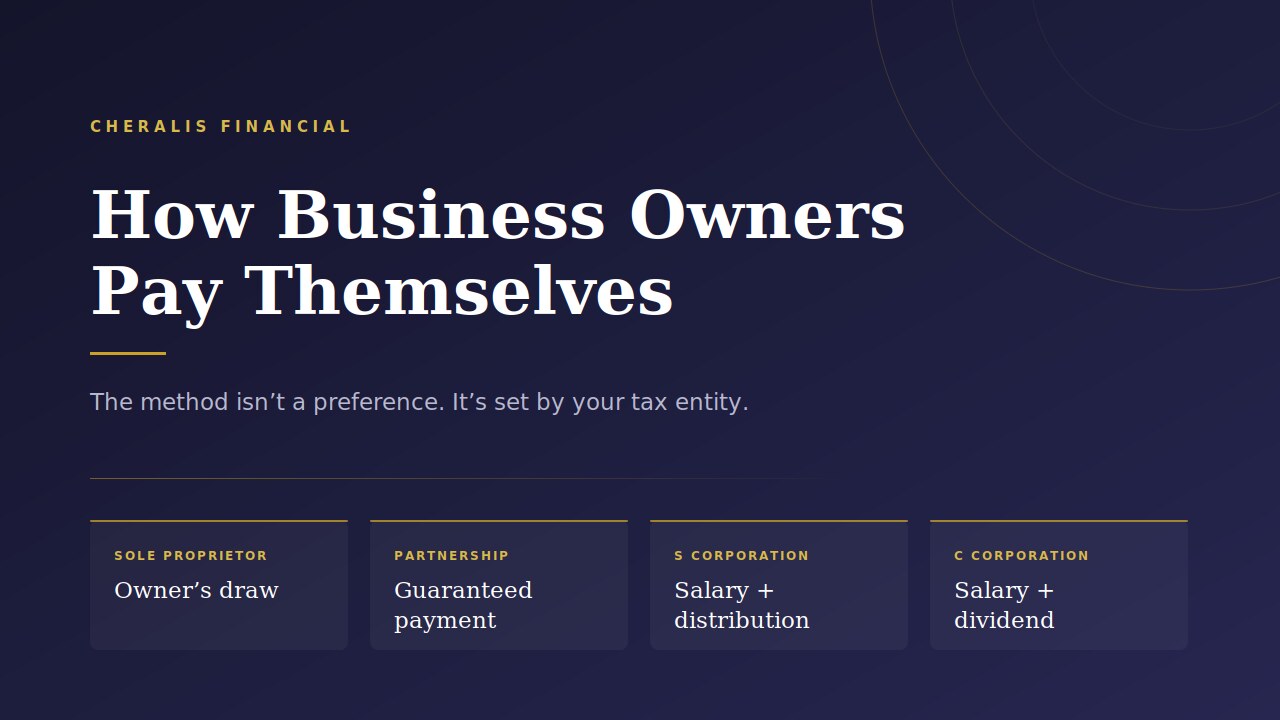
Most business owners get paid the wrong way at least once. Not because they’re careless, but because nobody ever told them that the money moving from the business account to the personal account is governed by rules — and that those rules change completely depending on how the business is taxed.
Take money out of a sole proprietorship and it’s a draw. Take the same money out of an S corporation the same way and you may have just created a payroll tax problem the IRS can assess penalties on. Same dollar, same bank transfer, entirely different consequences.
This article walks through how owners of each tax entity type are supposed to pay themselves, what the law actually requires, and what you should do next.
First: your legal entity is not your tax entity
This is the single most common point of confusion, so let’s clear it before anything else.
An LLC is a legal structure, not a tax classification. The IRS doesn’t have an “LLC” tax return. Instead, your LLC is taxed as one of four things:
- A sole proprietorship (single-member LLC, by default)
- A partnership (multi-member LLC, by default)
- An S corporation (if you elect it on Form 2553)
- A C corporation (if you elect it on Form 8832)
So when someone asks “how should I pay myself as an LLC?”, the honest answer is: it depends on which of those four boxes you’re in. The LLC part tells you about liability protection. The tax election tells you how you get paid.
Find your tax classification first. Everything below follows from it.
Sole proprietorships and single-member LLCs: the owner’s draw
If you’re a sole proprietor — including a single-member LLC that hasn’t made an election — you and your business are the same taxpayer in the eyes of the IRS. Your business income flows onto Schedule C of your personal Form 1040.
How you pay yourself: an owner’s draw. You transfer money from the business account to your personal account. That’s it. There’s no payroll, no W-2, no withholding.
The rule most owners misunderstand: you are taxed on your net profit, not on what you withdraw. If your business nets $120,000 and you only draw $60,000, you still owe tax on the full $120,000. Leaving money in the business account does not defer the tax. The draw itself is not a taxable event and it is not a deductible business expense — it’s simply a movement of your own money.
You cannot put yourself on payroll. A sole proprietor is not an employee of their own business. Issuing yourself a W-2 here is an error that has to be unwound.
What you owe:
- Income tax on net profit at your ordinary rates
- Self-employment tax — 15.3% on net earnings from self-employment (12.4% Social Security up to an annually adjusted wage base, plus 2.9% Medicare with no cap). This is you paying both halves of FICA. You do get to deduct half of it as an adjustment to income.
How you actually pay it: quarterly estimated tax payments using Form 1040-ES, generally due April 15, June 15, September 15, and January 15. Nobody is withholding for you, so if you skip these, you’ll face an underpayment penalty at filing.
Partnerships and multi-member LLCs: guaranteed payments and distributions
If two or more people own the business and you haven’t elected corporate treatment, you’re taxed as a partnership. The partnership files Form 1065 and issues each partner a Schedule K-1.
Partners have two ways to receive money, and the distinction matters.
1. Guaranteed payments
A guaranteed payment (Internal Revenue Code §707(c)) is compensation to a partner for services or use of capital, paid regardless of whether the partnership turns a profit. Think of it as the partnership equivalent of a salary — except it isn’t one.
- It’s deductible to the partnership
- It’s ordinary income to the partner
- It’s subject to self-employment tax
- It’s reported on the partner’s K-1, not a W-2
2. Distributive share and distributions
Your distributive share is your slice of partnership profit, set by the partnership agreement. It hits your K-1 and you’re taxed on it whether or not the cash is ever distributed to you — the same “taxed on profit, not on withdrawal” principle as a sole proprietorship.
An actual distribution of cash is generally not a second taxable event, because you already paid tax on the profit. But there’s a trap: distributions in excess of your basis are taxable as capital gain. Basis tracking is not optional bookkeeping — it’s what determines whether a withdrawal is tax-free or triggers a bill.
The hard rule: a partner cannot be a W-2 employee of their own partnership (Revenue Ruling 69-184). This is a genuinely common mistake, especially in multi-member LLCs where the owners think of themselves as staff. Putting a partner on payroll requires correction.
Partners, like sole proprietors, pay in through quarterly estimated taxes.
S corporations: the reasonable salary rule
This is where owners get into the most trouble, and where the most money is at stake.
An S corp is a tax election, available to an LLC or a corporation. The entity files Form 1120-S and issues K-1s. Profit passes through to owners without an entity-level tax — which sounds like the sole proprietor setup, but the payment mechanics are entirely different.
If you work in your S corporation, you are an employee of it. You must be on payroll. You must receive a W-2. And that salary must be reasonable compensation for the work you actually perform.
Here’s why this rule exists. In an S corp, money comes to you in two streams:
| Stream | Payroll/FICA tax? | Income tax? |
|---|---|---|
| W-2 salary | Yes — 7.65% employee + 7.65% employer | Yes |
| Distributions | No | Yes |
Distributions escape payroll tax. That’s the legitimate advantage of the S corp — and it’s exactly why the IRS polices it. An owner who pays themselves a $12,000 salary and takes $150,000 in distributions has, in the IRS’s view, disguised wages as distributions to dodge FICA.
The IRS will reclassify unreasonably low salaries as wages, and assess the back payroll taxes plus penalties and interest. This isn’t theoretical. In Watson v. Commissioner, an accountant paid himself a $24,000 salary while taking roughly $175,000 in distributions from a profitable firm; the courts backed the IRS in reclassifying a large portion as wages.
What makes a salary “reasonable”? There’s no formula in the code, but the IRS and courts weigh factors including:
- Your training, experience, and duties
- Time and effort devoted to the business
- What comparable businesses pay for comparable work
- The company’s dividend/distribution history
- Payments to non-owner employees
- Whether compensation agreements are formal and consistent
The practical standard: what would you have to pay an outsider to do your job? Document how you arrived at the number. Comparable-salary data, a written compensation policy, and consistent application are what turn a defensible position into a defensible record.
Two S corp details that catch owners off guard:
- Health insurance for >2% shareholders. Premiums paid by the company must be added to Box 1 of your W-2 (though not subject to FICA), and you then deduct them as self-employed health insurance on your 1040. Skipping this step is a very common error.
- Basis limits distributions. Just like a partnership, distributions in excess of stock basis produce capital gain. And an S corp with insufficient earnings can’t distribute freely.
Payroll is a compliance obligation, not a preference. Once you elect S corp status and work in the business, you owe payroll filings (941s, 940, W-2s, state equivalents) and payroll tax deposits on schedule. Missed payroll deposits carry some of the harshest penalties in the code — including the Trust Fund Recovery Penalty, which can reach owners personally.
C corporations: salary, dividends, and double taxation
A C corporation is a separate taxpayer. It files Form 1120 and pays a flat 21% federal corporate income tax on its profits.
Owners who work in the business are employees and take a W-2 salary, just as in an S corp. That salary is deductible to the corporation, which reduces corporate taxable income.
Profits distributed to shareholders come out as dividends — and here’s the defining feature of the C corp: dividends are not deductible to the corporation. The company pays 21% on the profit, then you pay tax again on the dividend at qualified-dividend rates (0%, 15%, or 20% depending on income). That’s double taxation.
Interestingly, the reasonable-compensation rule runs the opposite direction here. In an S corp, the IRS attacks salaries that are too low. In a C corp, it attacks salaries that are too high — because an inflated salary strips out corporate profit that should have been taxed at the entity level and distributed as a dividend. Excessive compensation gets reclassified as a disguised dividend, losing the deduction.
C corps also can’t be used to shelter earnings indefinitely; the accumulated earnings tax exists to discourage hoarding profits solely to avoid shareholder-level tax.
Side-by-side
| How you get paid | Payroll? | Self-employment / FICA | Key form | |
|---|---|---|---|---|
| Sole prop / SMLLC | Owner’s draw | Never | SE tax on all net profit | Schedule C |
| Partnership / MMLLC | Guaranteed payments + distributions | Never | SE tax on guaranteed payments & (generally) distributive share | 1065 / K-1 |
| S corporation | Reasonable W-2 salary + distributions | Required | FICA on salary only | 1120-S / K-1 / W-2 |
| C corporation | W-2 salary + dividends | Required | FICA on salary; dividends double-taxed | 1120 / W-2 / 1099-DIV |
Your steps forward
1. Confirm your actual tax classification. Not what you think you are — what’s on file. Check your last filed return and any Form 2553 or 8832 you submitted. If you’re a single-member LLC that never elected anything, you’re a sole proprietor for tax purposes.
2. Match your payment method to that classification. If there’s a mismatch — an S corp owner taking draws with no payroll, or a partner receiving a W-2 — stop and fix it. The longer a misclassification runs, the more expensive the cleanup.
3. If you’re an S corp, set and document a reasonable salary. Run payroll on a consistent schedule. Write down the reasoning and comparable data behind your number before the IRS ever asks.
4. Separate business and personal accounts completely. Every draw, guaranteed payment, and distribution should be a clean, traceable transfer. Commingled accounts are the single fastest way to lose liability protection and make an audit far worse than it needed to be.
5. Track your basis. Especially in partnerships and S corps. It’s what determines whether your next distribution is tax-free or a taxable gain.
6. Fund your taxes as you go. If you’re a pass-through owner, set aside a percentage of every deposit and make your quarterly estimated payments. A common safe harbor: pay in at least 100% of last year’s total tax (110% if your AGI exceeded $150,000), or 90% of the current year’s — that generally shields you from underpayment penalties.
7. Set up an accountable plan for reimbursements. Home office, mileage, and business use of personal assets can be reimbursed to you tax-free by the business — but only if you have a proper accountable plan with documentation. Without one, those reimbursements can become taxable income.
8. Revisit the entity choice itself. The S election can save meaningful payroll tax once profit is high enough to support a reasonable salary plus distributions. Below that threshold, the added payroll and compliance cost may exceed the savings. This is a math problem specific to your numbers, not a rule of thumb.
The bottom line
Paying yourself correctly isn’t a formality — it’s the difference between a clean return and a reclassification notice with penalties attached. The rules are knowable, and once your entity type and payment method are aligned, the process becomes routine.
If you’re unsure where you stand, or you suspect you’ve been paying yourself the wrong way, get it reviewed before the IRS reviews it for you. Correcting a misclassification proactively is dramatically cheaper than defending one.